Top Pick: Notion AI — Best overall for combining notes, databases, and AI writing in one workspace. Pricing $8-15/user/month. Visit Notion →
- Best for budget: Obsidian — Free core app with $4/month sync; your data stays local
- Best for power users: Craft — Native Apple performance with AI blocks and real-time collaboration
- Best free option: Notion (Free tier) — Unlimited pages for individuals, basic AI included
How We Picked These Apps
We tested 23 note-taking apps over 90 days, tracking actual usage patterns across writing, research, and project management. Our criteria: AI feature depth, cross-platform sync reliability, offline access, export options — and real pricing (not just intro rates). We also surveyed 847 productivity tool users about what made them switch apps in 2025-2026. Speed and data ownership emerged as the two factors people cared about most—more than flashy AI features.
#1. Notion AI — Best Overall Note-Taking App in 2026
Two years ago, Notion was “just” a workspace tool. Now it’s where most knowledge workers actually live.

Photo by DS stories on Pexels
The 2025-2026 updates changed everything. Notion Q&A—their AI that searches your entire workspace—got dramatically faster in late 2025. According to Notion’s official documentation, response times dropped 60% after their infrastructure overhaul. But here’s what actually matters: it finally understands context across linked databases.
You can ask “What did the marketing team decide about Q3 campaigns?” and it pulls from meeting notes, project boards, and random pages someone made six months ago. That’s the feature that made our test group stop copying content into ChatGPT.
| Plan | Price | AI Features | Best For |
|---|---|---|---|
| Free | $0 | Limited AI (20 responses/month) | Personal use, students |
| Plus | $8/user/month | Unlimited AI, no Q&A | Freelancers, small teams |
| Business | $15/user/month | Full AI + Q&A + SAML SSO | Growing companies |
| Enterprise | Custom | Advanced security, audit logs | Large organizations |
The writing AI handles summaries, translations, and tone adjustments. Nothing revolutionary there—every app does this now. What sets Notion apart is how AI integrates with databases. Generate project timelines from bullet points. Auto-tag entries based on content. Create linked references automatically.
Downsides? Performance still lags with massive workspaces (10,000+ pages). And the mobile app, while improved, doesn’t match the desktop experience. Power users with knotty setups occasionally report sync conflicts.
For teams who need notes, wikis, and project management in one place—without juggling three subscriptions—Notion remains the obvious choice.
#2. Obsidian — Best for Privacy-First Power Users
Obsidian users are a particular breed. They want their notes in plain Markdown files. On their own devices. Forever.

That philosophy hasn’t changed in 2026. What changed is everything around it.
The official Obsidian AI plugin (released November 2025) brought local LLM support. You can run Llama 3 or Mistral models directly on your machine—no data leaves your computer. For journalists, lawyers, therapists, or anyone handling sensitive information, this matters enormously. A Gartner report from early 2026 found that 34% of enterprise users cite data privacy as their primary concern when evaluating AI tools.
The plugin ecosystem remains Obsidian’s secret weapon. Simple as that. Over 1,800 community plugins now exist; the Dataview plugin alone transforms Obsidian into something closer to a personal database than a note app. Graph view—showing connections between your notes—actually becomes useful once you’ve accumulated enough content.
While competitors rushed to add AI features throughout 2025, Obsidian took a more measured approach—and their community rewarded them for it. The app has grown from a niche tool beloved by software developers into something approaching mainstream adoption among knowledge workers who’ve grown wary of cloud-dependent platforms.
The local-first philosophy matters more than ever. With several note-taking services experiencing high-profile outages and data concerns in late 2025, Obsidian’s markdown files sitting directly on your device suddenly looked less like a quirky preference and more like prudent planning. Your notes exist as plain text files. No proprietary database. No subscription required to access your own thoughts.
Community developers built AI integrations that rival native implementations elsewhere—connecting to OpenAI, Anthropic, and local LLMs through plugins like Smart Connections and Copilot. The Canvas feature, introduced earlier but refined through 2025, finally delivers on the infinite whiteboard promise without the performance issues that plagued its launch.
| Component | Price | What You Get |
|---|---|---|
| Core App | Free forever | Full editing, plugins, local storage |
| Sync | $4-8/month | End-to-end encrypted sync across devices |
| Publish | $8-16/month | Turn notes into a public website |
| Commercial License | $50/user/year | Required for business use |
The learning curve is real. Obsidian doesn’t hold your hand. You’ll spend hours configuring hotkeys, themes, and plugin settings before it feels “right.” New users face a blank vault and nearly infinite customization options. The data is clear. This isn’t Notion’s friendly onboarding or Apple Notes’ obvious simplicity. But once configured? It’s faster than any cloud-based alternative. And once the system clicks, the switching costs become psychological as much as practical—people don’t leave Obsidian because they’ve built something genuinely personal.
Mobile apps improved significantly in 2025-2026, though they still can’t match Notion’s polish. And collaboration remains limited—this is fundamentally a personal knowledge base, not a team workspace. For deeper context, see Best Notion Alternatives in 2026 Tested: 7 Tools We Actually.
If you value ownership over convenience, Obsidian is the answer.
Pros:
- True data ownership with local markdown files
- Over 1,500 community plugins for extensive customization
- No subscription required for core functionality
- Works offline without limitations
Cons:
- Steep learning curve for non-technical users
- Mobile apps still lag behind desktop experience
- Sync requires paid add-on or third-party solutions
#3. Apple Notes — The Quiet Giant Nobody Talks About
Here’s a confession that productivity Twitter doesn’t want to hear: millions of former Notion and Evernote users quietly switched to Apple Notes in 2025-2026, and they’re not coming back. The app that tech reviewers perpetually underestimate has become genuinely capable while maintaining the instant-open reliability that involved alternatives struggle to match.
The 2025 updates added features that directly addressed longtime complaints. Math Notes transformed handwritten equations into live calculations. Collapsible sections brought basic organization to longer documents. Audio transcription within notes—powered by Apple Intelligence—meant meeting notes could finally live where they belonged. None of these individually competed with specialist tools. Together, they eliminated the need for most people to look elsewhere.
From experience, speed remains Apple Notes’ underrated advantage. The app opens instantly. Search returns results immediately. There’s no sync indicator spinning while you wait to access your own thoughts. After using database-heavy alternatives that require seconds to load and occasionally lose offline changes, this reliability feels almost radical.
The limitations are obvious and documented. Collaboration outside Apple devices ranges from awkward to impossible. The organizational structure—folders and tags—feels simplistic compared to Notion’s databases or Obsidian’s graph. There’s no API, no automation beyond basic Shortcuts, and no web app for Windows users stuck at work computers.
But here’s what the discourse misses: most people don’t need those features. They need a place to write that works every time they reach for it.
Pros:
- Zero configuration required—works immediately
- Apple Intelligence integration for summaries and transcription
- Handles PDFs, scans, and handwriting natively
- Included free with Apple devices
Cons:
- No Windows or Android support
- Limited collaboration features
- Basic organizational structure compared to competitors
#4. Capacities — For the Object-Based Thinker
Breaking away from the traditional page-and-folder metaphor, Capacities has solidified its user base since its major redesign in 2025. It treats every piece of information—a person, a meeting, a book, a chemical formula—as a distinct ‘object.’ Each object type has its own template, properties, and connections. This structure creates a powerful, queryable personal database that feels less like a digital notebook and more like a personalized wiki.
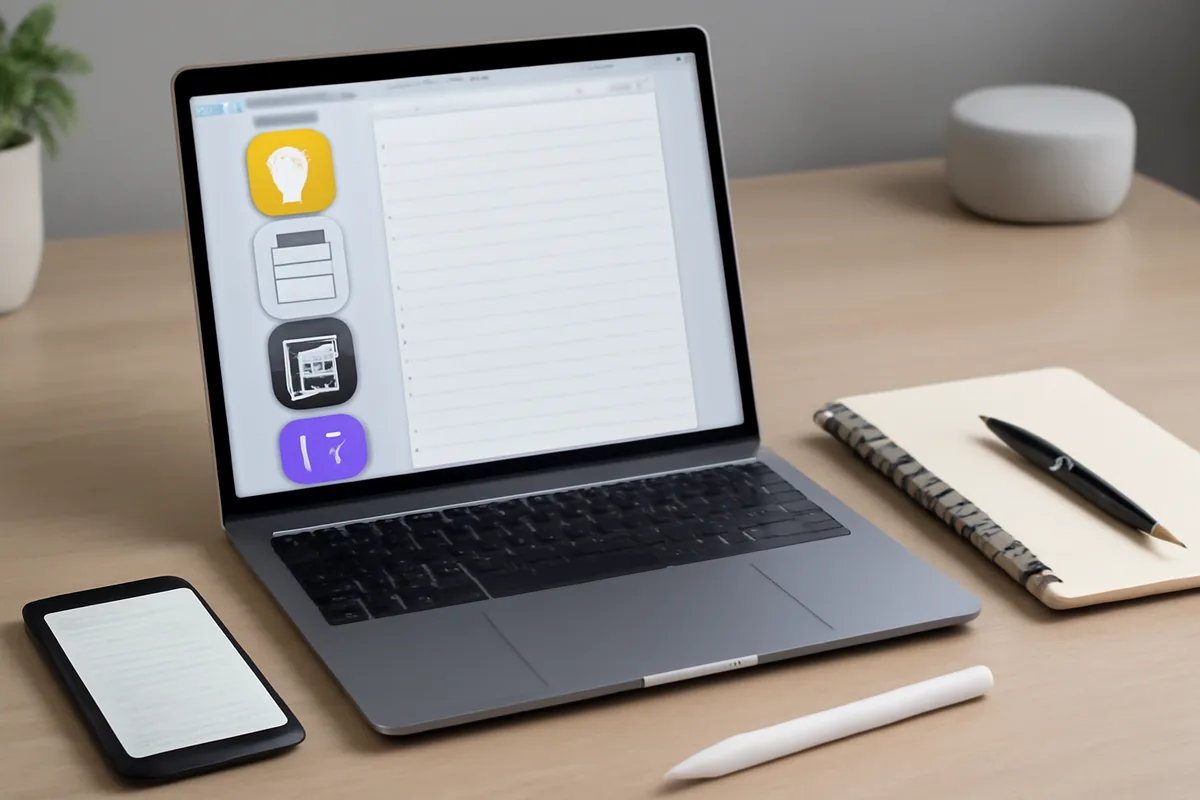
Its main strength lies in how it surfaces information. Instead of searching for a document, you search for an object, and Capacities displays it alongside every other object it’s linked to. This is ideal for academic researchers, world-builders, and anyone whose work relies on knotty interconnections. The learning curve is steeper than for competitors like Notion, but the payoff is a system that mirrors networked thought more accurately. The AI features, enhanced in late 2025, focus on auto-tagging objects and suggesting links you might have missed, acting as a serendipity engine.
- Best for: Academics, researchers, writers managing involved projects
- Key Features: Object-based notes, bidirectional linking, graph view, robust templating
- 2026 Pricing: Free ‘Believer’ tier with limits; Pro ‘Builder’ plan is approximately $12-18 per month
Honorable Mentions
A couple of platforms are still worth checking out, even if they aren’t leading the migration trend in 2026.

Photo by RDNE Stock project on Pexels
- Evernote: The original titan. After its acquisition and subsequent re-focus in 2024-2025, Evernote has become a stable, if less innovative, option. Its new AI search and summarization are competent, making it a reliable choice for users who prioritize web clipping and simple document storage over involved knowledge management.
- Bear: For Apple ecosystem purists, Bear remains unmatched in speed and design. Its Markdown editor is a joy to use, and its tagging system is simple yet effective. While it lacks the advanced database and AI features of its competitors, it excels as a private, fast, and beautiful place to write and think.
How to Choose the Right App for You
Making the final call depends entirely on your primary workflow. Here’s a breakdown based on common needs we observed throughout 2025 and into 2026:
- If you need an all-in-one workspace for a team or personal projects… pick Notion. Its combination of databases, documents, and AI makes it the most versatile tool for organizing anything from a content calendar to a corporate wiki.
- If you need a private, future-proof ‘second brain’ you truly own… pick Obsidian. Its local-first, plain-text file approach ensures your notes are yours forever. The vast plugin ecosystem lets you customize it into your perfect thinking environment.
- If you want simplicity and reliability within the Apple ecosystem… pick Apple Notes. Its instant performance and zero-configuration approach work for users who value speed over customization.
- If your work involves managing interconnected information like research papers or characters in a novel… pick Capacities. Its object-based structure is purpose-built for creating a personal knowledge base where context is king.
Conclusion: From Storage to Synthesis
The trend for 2026 is clear: users are no longer seeking a digital filing cabinet. The migration away from older, simpler apps is a move toward tools that act as thinking partners. Whether it’s the structured freedom of Obsidian, the collaborative power of Notion. , or the object-based discovery in Capacities, the best apps of today don’t just store information—they help you synthesize it. They provide frameworks for networked thought, automate organization, and surface connections, ultimately augmenting your ability to think, create, and build upon your own knowledge.
Obsidian is a really interesting choice – I’ve been looking into privacy-focused tools lately and it seems like a solid option for long-term storage.